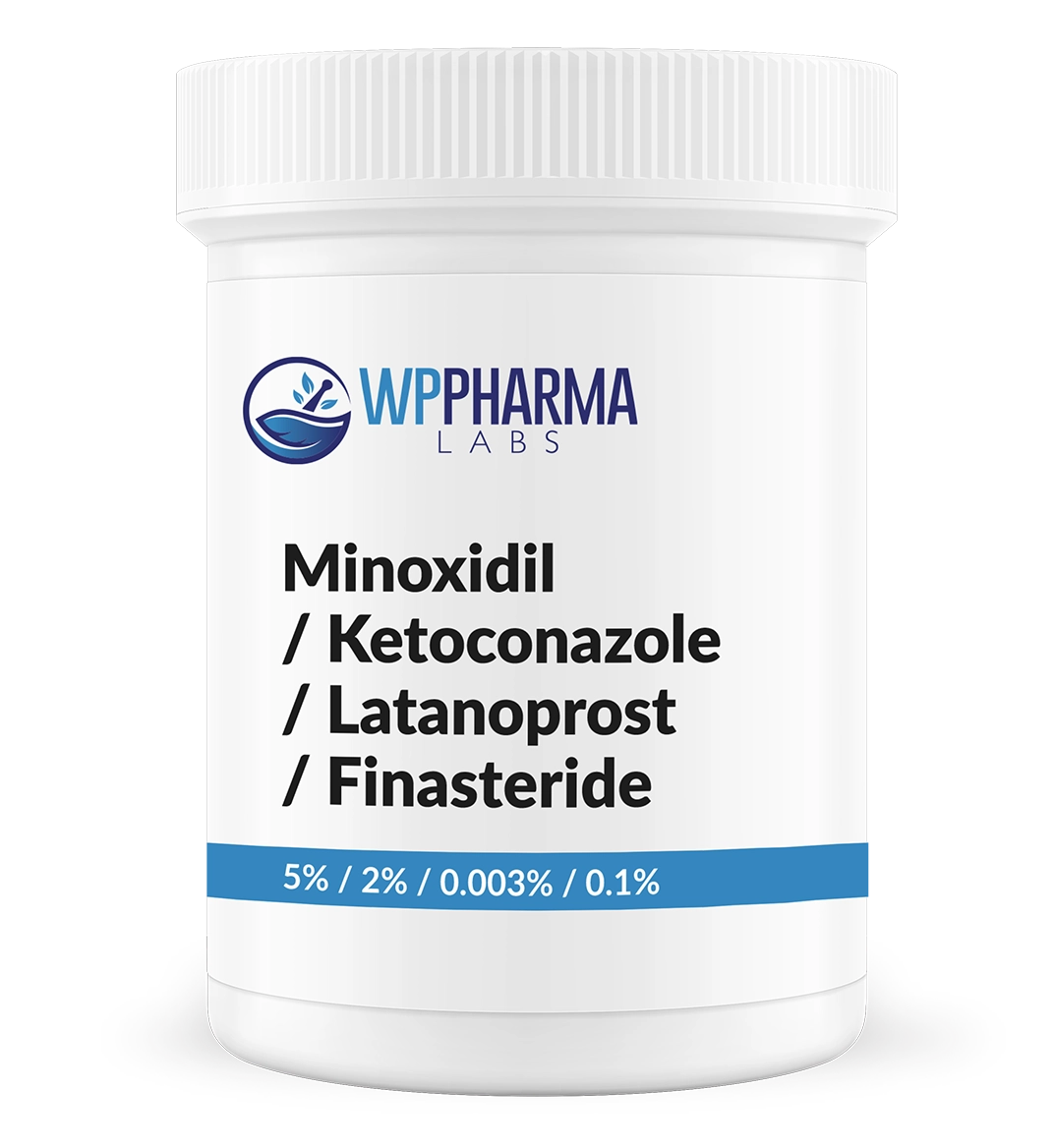
Minoxidil / Ketoconazole / Latanoprost / Finasteride

Lotion

5% / 2% / 0.003% / 0.1%

Ready to prescribe?
Disclaimer: Images are for reference only; actual products may vary.

Product Overview

The following drugs have been combined into a lotion for the treatment of hair loss.

Minoxidil1-17

Topical minoxidil is a vasodilator initially developed as an oral antihypertensive agent. Hair growth stimulation was observed as a side effect (hypertrichosis, or excessive abnormal hair growth) in patients taking oral minoxidil. Based on these observations, minoxidil was subsequently FDA-approved for androgenetic alopecia in both men and women.

Ketoconazole1-17

Ketoconazole is a synthetic imidazole antifungal commonly used in both topical and oral formulations. Topically, ketoconazole has been used to promote hair growth, particularly in androgenetic alopecia and hair loss associated with seborrheic dermatitis. It is often compounded into shampoos, foams, or lotions, either alone or in combination with agents such as minoxidil or finasteride to enhance effectiveness.

Latanoprost1-17

Latanoprost is a prostaglandin F2α (PGF2α) analog primarily used to treat open-angle glaucoma and ocular hypertension. Evidence suggests that latanoprost can promote hair growth, particularly in androgenetic alopecia and in eyelash or eyebrow hypotrichosis. Its hair regrowth potential was first noted due to the side effect of increased eyelash growth in patients treated for glaucoma.

Finasteride1-17

Finasteride is a 5-alpha reductase inhibitor that has been shown to benefit men with symptomatic benign prostatic hyperplasia, a condition affecting men over the age of 50. Finasteride is also used in the management of androgenetic alopecia (male pattern hair loss).

Mechanism of Action1-7,10-17

Minoxidil

The drug has many mechanisms in supporting hair growth:

  • Potassium channel opening: Minoxidil is a K⁺-ATP channel opener, resulting in vasodilation and enhanced blood flow to hair follicles.
  • Prolongation of the hair cycle: It extends the growth phase of the hair cycle, leading to increased follicle size and more robust hair shafts.
  • Activation of prostaglandins: May indirectly affect prostaglandin-mediated signaling to stimulate hair follicle activity.
  • Upregulation of vascular endothelial growth factor (VEGF): Promotes angiogenesis in dermal papillae, improving follicular nourishment.

Ketoconazole

Mechanism of Action (in Hair Loss)

Antifungal Action:

Inhibits ergosterol synthesis, a critical component of fungal cell membranes, effectively treating Malassezia spp. overgrowth often seen in seborrheic dermatitis, which is linked to scalp inflammation and hair loss.

Anti-Androgenic Activity (indirect):Though not a systemic anti-androgen, ketoconazole may locally inhibit 5α-reductase, reducing dihydrotestosterone (DHT) formation in the scalp—a key factor in androgenetic alopecia.

Anti-Inflammatory Properties:

Reduces local scalp inflammation, which is a contributing factor in various forms of alopecia, including telogen effluvium and AGA.

Cleansing and Scalp Health:

Improves overall scalp environment by reducing sebum, scaling, and microbial overgrowth, thus promoting a more favorable environment for follicular health.

Latanoprost:

Latanoprost binds to the prostaglandin F2α receptor on hair follicle dermal papilla cells, influencing the hair growth cycle as follows:

  1. Prolongation of Anagen Phase (Growth Phase):

Increases the duration of anagen, resulting in longer and thicker hair shafts.

  1. Stimulation of Melanogenesis:

May enhance pigmentation in vellus hairs, making them appear darker and more terminal-like.

  1. Increased Follicular Density:

Some studies suggest latanoprost may increase the number of follicles actively producing hair, particularly in the eyelash and eyebrow regions, and potentially the scalp.

Finasteride

Finasteride is an analog of testosterone that acts as a competitive, specific inhibitor of type II 5-alpha-reductase, an intracellular enzyme that converts testosterone to the potent androgen 5-alpha-dihydrotestosterone. The type II 5-alpha-reductase isozyme is primarily found in prostate, seminal vesicles, epididymides, and hair follicles, as well as liver. Dihydrotestosterone has been shown to increase prostate growth and can lead to hair thinning. Finasteride has been shown to shrink the prostate to improve urinary flow and in the scalp lowers dihydrotestosterone to slow hair loss and promote regrowth.

Adverse Reactions1-7,10-17

Minoxidil

Common

Topical minoxidil is generally well tolerated but may cause local effects:

Local side effects (most common):

  • Scalp irritation, dryness, flaking
  • Erythema or contact dermatitis (more common with propylene glycol-containing formulations)
  • Pruritus or burning sensation
  • Unwanted facial hair growth (esp. in women or if solution drips onto other areas)


Ketoconazole

Common

  • Local irritation (erythema, stinging, burning)
  • Dryness or increased oiliness of scalp
  • Hair texture changes (dryness or stiffness)
  • Allergic contact dermatitis (rare)


Latanoprost

Common

  • Local irritation (itching, burning, erythema)
  • Hyperpigmentation of skin (especially around eyelids or eyebrows)
  • Increased pigmentation of treated hair
  • Eyelid darkening (rare with scalp use)
  • Unwanted hair growth if medication spreads to unintended areas
  • Eye irritation (if it migrates to eye area)


Finasteride

Adverse Reactions (with systematic absorption)

  • Decreased libido
  • Erectile dysfunction
  • Ejaculatory disorders (e.g., reduced volume)
  • Breast tenderness or enlargement
  • Gynecomastia

Contraindications & Precautions1-7,10-17

Minoxidil

Contraindications:

  • Known hypersensitivity to minoxidil or excipients (e.g., propylene glycol, alcohol)
  • Discontinuation advised if signs of hypersensitivity or severe irritation occur

Precautions:

  • Avoid use on broken or inflamed skin to minimize systemic absorption
  • Not for use in individuals under 18 years unless directed by a physician
  • Caution in patients with cardiovascular disease (though systemic absorption is typically minimal with proper use)
  • Avoid ocular contact — rinse thoroughly if accidental exposure occurs
  • Should not be used during pregnancy or lactation unless clinically indicated and under supervision

Ketoconazole

Contraindications:

  • Known hypersensitivity to ketoconazole or any excipients used in the compounded base
  • Active scalp infections not of fungal origin (e.g., bacterial folliculitis) unless co-treated appropriately

Precautions:

  • Use with caution in patients with open wounds or compromised skin integrity
  • Avoid eye exposure
  • Evaluate for signs of allergic contact dermatitis or worsening inflammation
  • Not recommended for use in children unless directed by a physician


Latanoprost

Contraindications:

  • Known hypersensitivity to latanoprost or prostaglandin analogs
  • Active ocular conditions if near eyes (without ophthalmologic approval)
  • History of herpetic keratitis (due to prostaglandin-induced reactivation risk)

Precautions:

  • Avoid application near the eyes unless specifically prescribed
  • Use gloves or applicator to prevent unintended hair growth on fingers/hands
  • Avoid contact with mucous membranes
  • Patients with a history of uveitis, macular edema, or intraocular surgery should be monitored if periorbital application is required


Finasteride

Contraindications & Precautions

Contraindications:

  • Contraindicated in women who are or may become pregnant due to risk of teratogenicity (can cause abnormalities in the external genitalia of male fetuses)
  • Hypersensitivity to finasteride or any component of the tablet

Precautions:

  • Finasteride lowers serum PSA levels by ~50% after 6 months, which can mask early detection of prostate cancer.
  • Use cautiously in patients with hepatic dysfunction. The drug is metabolized extensively in the liver.

Store in a cool, dry place, away from direct light and heat; Room temperature (20°C–25°C / 68°F–77°F) is ideal.

  1. Clinical Pharmacology [Internet].: Elsevier; accessed May 2025; Minoxidil topical monograph. Available from: ClinicalKey; https://www.clinicalkey.com/pharmacology/monograph/408?n=Minoxidil
  2. Rogaine® (minoxidil topical solution) package insert. Johnson & Johnson Consumer Inc. https://dailymed.nlm.nih.gov/dailymed/fda/fdaDrugXsl.cfm?setid=12fd18f0-859c-7b9a-e063-6394a90addbf&type=display Revised March 2024. Accessed June 16, 2025
  3. Goren A, Naccarato T. Minoxidil in the treatment of androgenetic alopecia. Dermatol Ther. 2018 Sep;31(5):e12686.
  4. Gupta, A.K., et al. (2003). The use of ketoconazole shampoo for the treatment and prophylaxis of dandruff and seborrheic dermatitis: A review. Journal of Cutaneous Medicine and Surgery, 7(1), 6–12.
  5. Pierard-Franchimont, C., et al. (1998). Ketoconazole shampoo: effect of long-term use in androgenic alopecia. Dermatology, 196(4), 474–477.
  6. Cordero, A., et al. (2021). Update on the use of topical ketoconazole in the management of androgenetic alopecia. Journal of Cosmetic Dermatology, 20(8), 2443–2451.
  7. Clinical Pharmacology Elsevier. Ketoconazole Monograph (Topical). Accessed 2025.
  8. PubChem CID: 3823 – Ketoconazole structure and properties.
  9. FDA Labeling (Nizoral Shampoo 2%) – Prescribing Information. https://www.accessdata.fda.gov/drugsatfda_docs/label/2013/019927s032lbl.pdf. Revised October 2013, Accessed June 16, 2025
  10. Johnstone, M. A. (1997). Hypertrichosis and increased pigmentation of eyelashes and adjacent hair in latanoprost therapy. American Journal of Ophthalmology, 120(7), 999–1001.
  11. Blume-Peytavi, U., et al. (2012). Latanoprost stimulates human scalp hair growth in vivo. Journal of the American Academy of Dermatology, 66(5), 807–814.
  12. Kwon, O. S., et al. (2007). Prostaglandin analogs as a potential treatment for hair loss: Latanoprost and bimatoprost in the management of alopecia. International Journal of Dermatology, 46(9), 1044–1048.
  13. Clinical Pharmacology. Elsevier. Latanoprost Monograph. Accessed 2025
  14. FDA Drug Label: Xalatan (latanoprost ophthalmic solution)
  15. Finasteride (Proscar) package insert. Issued October 2010. Accessed June 5, 2025. accessdata.fda.gov/drugsatfda_docs/label/2010/020180s037lbl.pdf
  16. Finasteride (Propecia) package insert. Revised March 2012. Accessed June 5, 2025. accessdata.fda.gov/drugsatfda_docs/label/2012/020788s020s021s023lbl.pdf.
  17. Clinical Pharmacology finasteride clinical monograph 2025 https://www.clinicalkey.com/pharmacology/

WPPL operates as a 503A compounding pharmacy and prepares individualized prescription medications pursuant to provider direction. Compounded preparations are not reviewed, tested, or approved by the FDA.

This listing also includes commercially manufactured products for convenience; these items are not compounded by our pharmacy and are sold as provided by their manufacturers. Actual products in stock at time of dispensing may vary due to supply chain variability. Any statements regarding non-compounded products are manufacturer-supplied, have not been evaluated by the FDA, and are not intended to diagnose, treat, cure, or prevent any disease. WPPL does not verify or endorse any therapeutic claims made by manufacturers. Please refer to original labeling for complete product information.

EXPLORE MORE

Related Medications

Licensed to ship across the U.S.

Your orders arrive promptly and privately, delivered directly to your door.

Providers: Let’s Partner for Better Patient Care

If you are a physician, clinic, or practice seeking a dependable Compounding Pharmacy partner, WP Pharma Labs is here to help. With dedicated account setup, streamlined ordering and responsive service, we support your therapeutic goals with specialized compounds designed for your patients.

To check product availability, check on the status of an existing order, request refills:
orders@wppharmalabs.com

New providers setup / update an existing account:
newaccounts@wppharmalabs.com