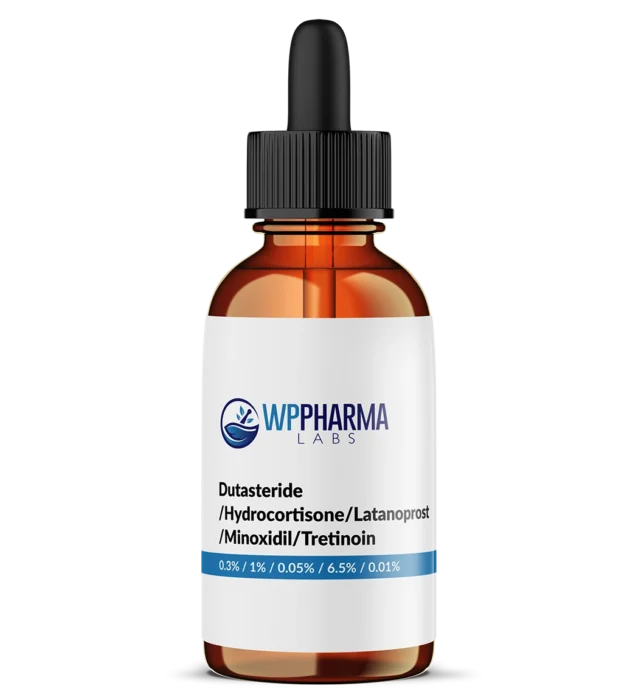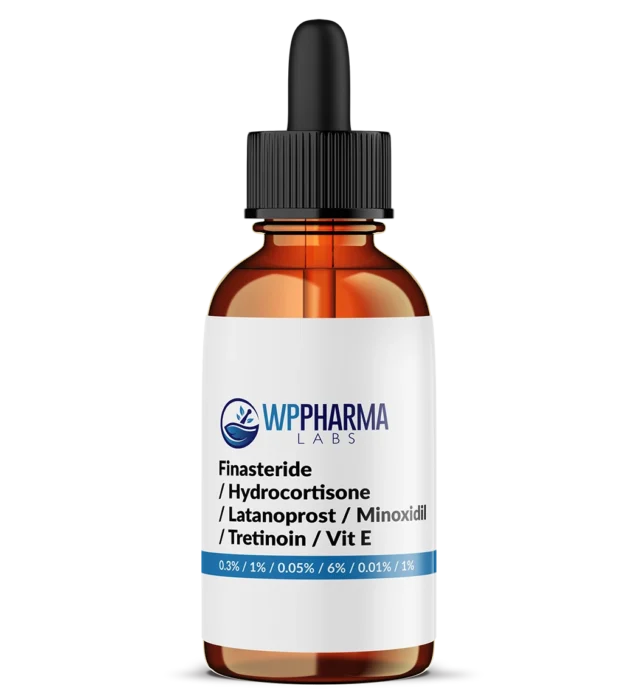
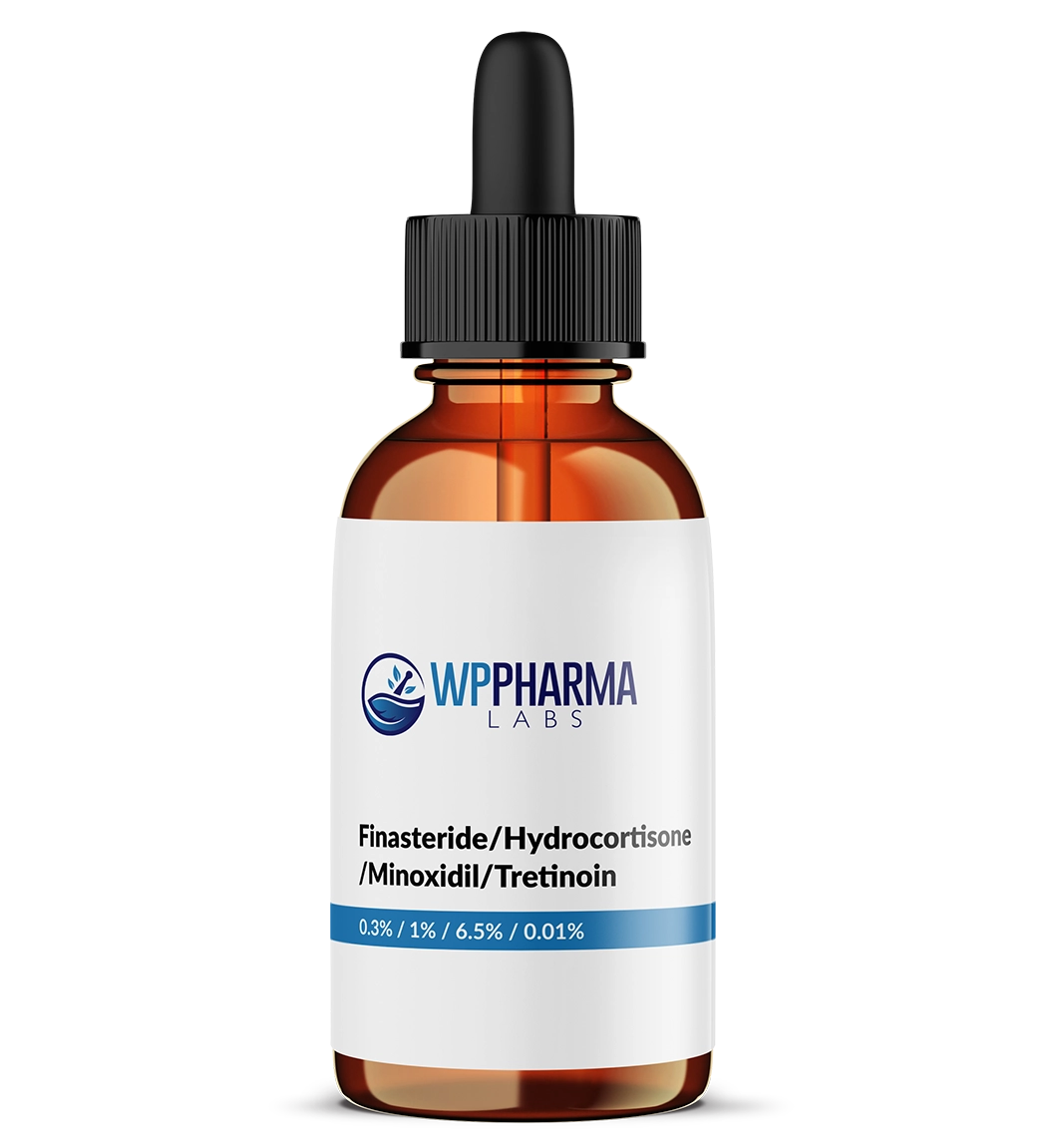
(FHLMT for Men) Solution
0.3% / 1% / 0.05% / 6.5% / 0.01%
Product Overview
This combination has been formulated as a topical preparation intended to address hair thinning and hair loss. Each component has a distinct mechanism of action related to hair development and follicular processes.
Finasteride Description1-3
Finasteride is a 5-alpha reductase inhibitor that has been shown to be beneficial in patients with symptomatic benign prostatic hyperplasia, a condition commonly affecting men over the age of 50. Finasteride has also been studied in relation to androgenetic alopecia, also known as male pattern hair loss.
Hydrocortisone4,5
Hydrocortisone is a synthetic form of cortisol, a hormone produced by the adrenal glands, and exhibits both glucocorticoid and mineralocorticoid activity. When applied topically, hydrocortisone demonstrates anti-inflammatory, antipruritic, anti-mitotic, and immunosuppressive effects. Among topical corticosteroids, hydrocortisone is classified as a low-potency option.
Latanoprost6-10
Latanoprost is an analogue of prostaglandin F2α (PGF2α) and is primarily indicated for the treatment of open-angle glaucoma and ocular hypertension. Observations have noted its association with hair growth, particularly in conditions such as androgenetic alopecia and eyelash or eyebrow hypotrichosis. Interest in its role in hair regrowth originated from reports of increased eyelash growth in individuals treated with latanoprost for glaucoma.
Minoxidil11-13
Topical minoxidil is a vasodilator that was originally developed as an oral antihypertensive medication. Hair growth effects were identified following reports of hypertrichosis in patients receiving oral minoxidil. As a result, topical minoxidil was later approved by the FDA for the treatment of androgenetic alopecia in both men and women.
Tretinoin14-18
Tretinoin is a naturally occurring derivative of vitamin A, also referred to as all-trans-retinoic acid. Retinoids are involved in the regulation of cell reproduction, proliferation, and differentiation. When combined with minoxidil, tretinoin has been associated with increased expression of specific markers related to hair growth, including Erk, Akt, Bcl-2, and Bax.
Finasteride1-3
Finasteride is an analog of testosterone that acts as a competitive, specific inhibitor of type II 5-alpha-reductase, an intracellular enzyme that converts testosterone to the potent androgen 5-alpha-dihydrotestosterone. The type II 5-alpha-reductase isozyme is primarily found in prostate, seminal vesicles, epididymides, and hair follicles, as well as liver. Dihydrotestosterone has been shown to increase prostate growth and can lead to hair thinning. Finasteride has been shown to shrink the prostate to improve urinary flow and in scalp lowers dihydrotestosterone to slow hair loss and promote regrowth.
Hydrocortisone4,5
The anti-inflammatory effects of topical hydrocortisone may occur through vasoconstriction. The vasoconstriction minimizes inflammatory mediators delivered to the inflamed area. Topical hydrocortisone may also inhibit the release of phospholipase A2, which reduces prostaglandins and leukotriene. Lastly, topical hydrocortisone inhibits DNA and transcription factors related to inflammation. It does this by increasing the expression of anti-inflammatory genes and indirectly inhibit inflammatory transcription factors, such as NF-kB, to decrease the expression of pro-inflammatory genes.
Topical hydrocortisone also has an anti-mitotic effect by decreasing epidermal mitosis mediated through an increase in lipocortin, an endogenous glucocorticoid-regulated protein.
Topical hydrocortisone also inhibits humoral factors in the inflammatory response by suppressing immune cells from maturing, differentiating and proliferating.
Latanoprost6-10
Latanoprost binds to the prostaglandin F2α receptor on hair follicle dermal papilla cells, influencing the hair growth cycle as follows:
Increases the duration of anagen, which may result in longer and thicker hair shafts.
May enhance pigmentation in vellus hairs, which may make them appear darker and more terminal-like.
Some studies suggest latanoprost may increase the number of follicles actively producing hair, particularly in the eyelash and eyebrow regions, and potentially the scalp.
Minoxidil11-13
The drug has many mechanisms in supporting hair growth:
Tretinoin14-18
Tretinoin may have several mechanisms to facilitate hair growth including the following:
Finasteride1-3,18
Common
With systematic absorption (rare)
Hydrocortisone4
Common
Latanoprost9,10
Common
Minoxidil11-13
Common
Topical minoxidil is generally well tolerated but may cause local effects:
Tretinoin14
Common
Contraindications1-4,9,10-14,18
Precautions1-4,9,10-14,18
Store at room temperatures between (59-86°F). Protect from light and keep the container tightly closed. Women should not handle crushed or broken finasteride tablets when they are pregnant or may potentially be pregnant because of the possibility of absorption of finasteride and the subsequent potential risk to a male fetus. Keep out of reach of children and pets.
WPPL operates as a 503A compounding pharmacy and prepares individualized prescription medications pursuant to provider direction. Compounded preparations are not reviewed, tested, or approved by the FDA.
This listing also includes commercially manufactured products for convenience; these items are not compounded by our pharmacy and are sold as provided by their manufacturers. Any statements regarding non-compounded products are manufacturer-supplied, have not been evaluated by the FDA, and are not intended to diagnose, treat, cure, or prevent any disease. WPPL does not verify or endorse any therapeutic claims made by manufacturers. Please refer to original labeling for complete product information.
EXPLORE MORE
Related Medications
Licensed to ship across the U.S.
Your orders arrive promptly and privately, delivered directly to your door.
Providers: Let’s Partner for Better Patient Care
If you are a physician, clinic, or practice seeking a dependable Compounding Pharmacy partner, WP Pharma Labs is here to help. With dedicated account setup, streamlined ordering and responsive service, we support your therapeutic goals with specialized compounds designed for your patients.
To check product availability, check on the status of an existing order, request refills:
orders@wppharmalabs.com
New providers setup / update an existing account:
newaccounts@wppharmalabs.com