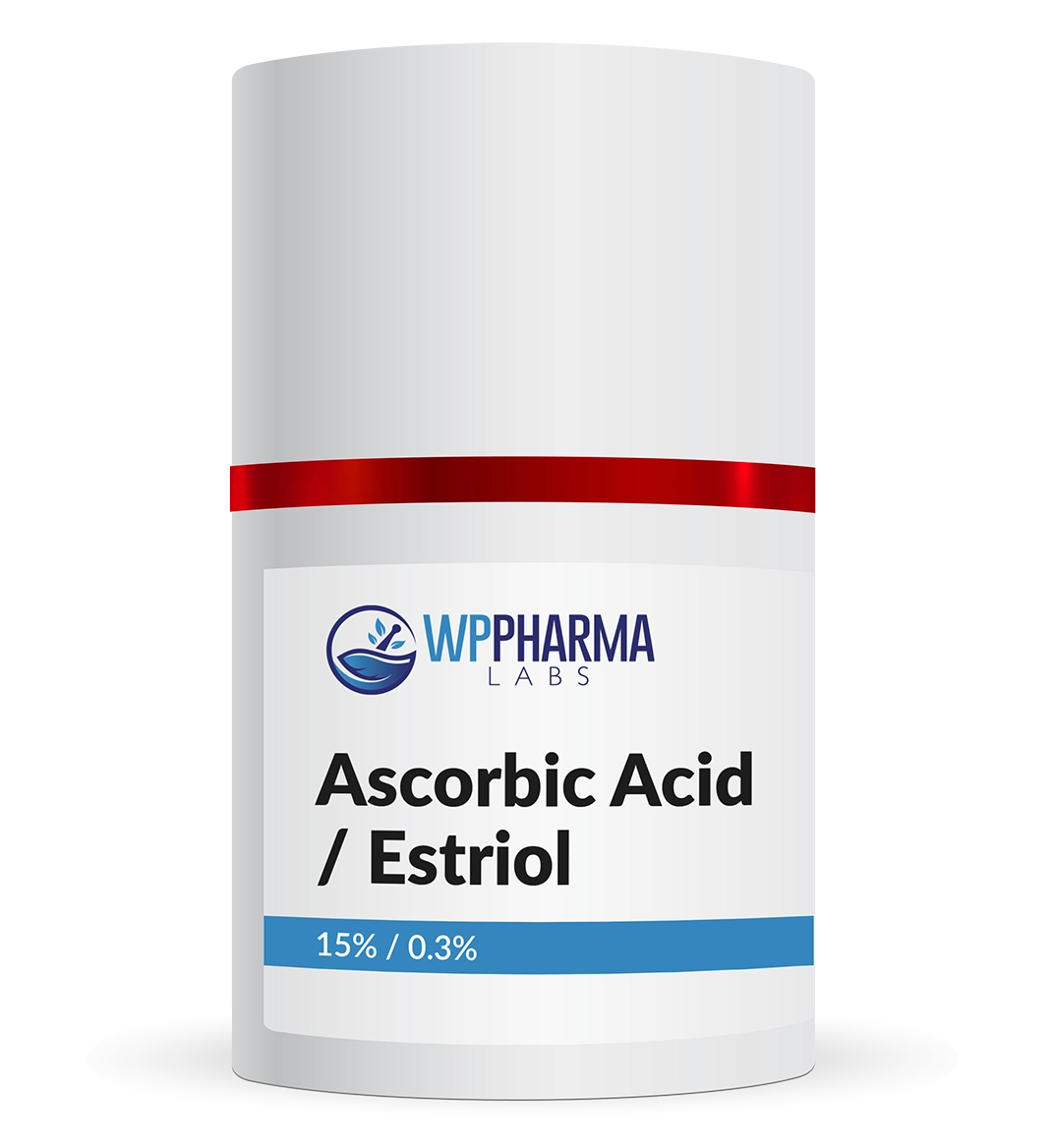
Ascorbic Acid / Estriol

Facial Cream

15% / 0.3%

Ready to prescribe?
Disclaimer: Images are for reference only; actual products may vary.

Product Overview

Ascorbic Acid / Estriol Cream is a compounded topical formulation used to address signs of skin aging, including fine lines, dullness, dryness, and reduced elasticity. Ascorbic acid functions as an antioxidant and may offer collagen-supporting properties, while estriol may contribute to skin hydration and structural support.

Ascorbic Acid1-5

Ascorbic acid, also known as vitamin C, is a water-soluble vitamin with antioxidant properties and serves as a key cofactor in collagen synthesis, carnitine and catecholamine metabolism, and dietary iron absorption. It plays an important role in maintaining skin integrity. In addition to its antioxidant effects on the skin, ascorbic acid exhibits anti-inflammatory activity, acts as a depigmenting agent, and supports collagen formation. Deficiency of ascorbic acid is associated with skin aging, making topical supplementation an approach used in skin anti-aging strategies.

Ascorbic acid is not synthesized by the body and must be obtained through dietary intake or supplementation. Common dietary sources include citrus fruits, berries, tomatoes, potatoes, and green leafy vegetables.

Estriol6-10

Micronized estriol is a bioidentical form of estriol (E3), one of the three naturally occurring estrogens in women, along with estradiol and estrone. Estriol is considered the weakest estrogen, with lower receptor binding affinity and a shorter duration of action compared to estradiol (E2). Despite its lower potency, estriol has demonstrated potential skin-related properties, including support for dermal thickness and elasticity. It is most commonly used in combination with estradiol in postmenopausal women with estrogen deficiency. Estriol is frequently compounded in a transdermal cream, allowing for gradual and adjustable dosing.

Ascorbic Acid1-5

Ascorbic acid functions in the aqueous compartments of the cell. As an antioxidant, ascorbic acid neutralizes free radicals by donating electrons to prevent oxidative stress. Reactive oxygen species are formed when skin is exposed to ultraviolet light forming superoxide ions, peroxide and singlet oxygen species. Ascorbic acid facilitates collagen development. It plays an important role in the maturation of collagen. It is a critical co-factor for prolyl hydroxylase and lysl hydroxylase. The level of ascorbic acid in the skin is directly tied to the structural integrity of dermal collagen. As a depigmenting agent, ascorbic acid interacts with copper ions at the tyrosinase‑active site and inhibits action of the enzyme tyrosinase, thereby minimizing the melanin formation. Ascorbic acid interferes with NFkB activity and thus decreases the activity of a number of pro‑inflammatory cytokines such as TNF‑alfa, IL1, IL6 and IL8.

Estriol6-10

Estriol acts by binding to estrogen receptors alpha (ERα) and beta (ERβ) in estrogen-responsive tissues, particularly the vaginal epithelium, bladder, urethra, and pelvic floor musculature.

Mechanisms and Effects:

  • Can help restore vaginal epithelial thickness and improves cell maturation index
  • Can improve blood flow, elasticity, and lubrication of vaginal tissues
  • Locally can improve thickening of dermal-epidermal junction, potentially improving skin firmness
  • May exert cytoprotective and anti-inflammatory effects on urogenital tissues

Common6-10

  • Transient burning, itching, or discharge
  • Spotting or light bleeding (usually resolves quickly)
  • Increased vaginal secretions

Systemic (rare at low doses)6-10

  • Breast tenderness
  • Headache
  • Nausea
  • Edema

Contraindications6-10

  • Hypersensitivity or intolerance to ascorbic acid or estriol
  • Active or history of estrogen-dependent cancers (e.g., breast, endometrial) — unless use is explicitly approved by an oncology or menopause specialist
  • Active or recent thromboembolic disease
  • Undiagnosed abnormal genital bleeding
  • Severe liver dysfunction


Precautions6-10 

Use caution in:

  • Women with a history of estrogen-sensitive malignancy
  • Liver disease
  • Migraines with aura
  • Uncontrolled hypertension

Store at 20°C to 25°C (68°F to 77°F) in a dry place, away from heat and light. Keep out of reach of children.

  1. Telang PS. Vitamin C in dermatology. Indian Dermatol Online J. 2013 Apr;4(2):143-6. doi: 10.4103/2229-5178.110593.
  2. Abdullah M, Jamil RT, Attia FN. Vitamin C (Ascorbic Acid). StatPearls. May 1, 2023. Accessed July 31,2025
  3. Boo YC. Ascorbic Acid (Vitamin C) as a Cosmeceutical to Increase Dermal Collagen for Skin Antiaging Purposes: Emerging Combination Therapies. Antioxidants (Basel). 2022 Aug 26;11(9):1663.
  4. Al-Niaimi F, Chiang NYZ. Topical Vitamin C and the Skin: Mechanisms of Action and Clinical Applications. J Clin Aesthet Dermatol. 2017 Jul;10(7):14-17.
  5. Clinical Pharmacology ascorbic acid clinical monograph 2025 https://www.clinicalkey.com/pharmacology/
  6. Cynthia A. Stuenkel, Susan R. Davis, Anne Gompel, Mary Ann Lumsden, M. Hassan Murad, JoAnn V. Pinkerton, Richard J. Santen, Treatment of Symptoms of the Menopause: An Endocrine Society Clinical Practice Guideline, The Journal of Clinical Endocrinology & Metabolism, Volume 100, Issue 11, 1 November 2015, Pages 3975–4011, accessed July 2025 through: https://doi.org/10.1210/jc.2015-2236
  7. North American Menopause Society (NAMS) Position Statement on Hormone Therapy (2022) Supports vaginal estrogen (including estriol) for GSM with minimal systemic risks; accessed July 2025 through: https://www.menopause.org/docs/default-source/professional/2022-nams-ht-position-statement.pdf
  8. NIH DailyMed, Estriol; accessed July 2025 though:  https://dailymed.nlm.nih.gov/dailymed/search.cfm?labeltype=all&query=estriol  
  9. Estriol: A Comprehensive Guide for Patients; accessed July 2025 through: https://clinicaltrials.eu/inn/estriol/  
  10. Rzepecki AK, Murase JE, Juran R, Fabi SG, McLellan BN. Estrogen-deficient skin: The role of topical therapy. Int J Womens Dermatol. 2019 Mar 15;5(2):85-90. Accessed July 2025; doi: 10.1016/j.ijwd.2019.01.001. PMID: 30997378; PMCID: PMC6451761

WPPL operates as a 503A compounding pharmacy and prepares individualized prescription medications pursuant to provider direction. Compounded preparations are not reviewed, tested, or approved by the FDA.

This listing also includes commercially manufactured products for convenience; these items are not compounded by our pharmacy and are sold as provided by their manufacturers. Actual products in stock at time of dispensing may vary due to supply chain variability. Any statements regarding non-compounded products are manufacturer-supplied, have not been evaluated by the FDA, and are not intended to diagnose, treat, cure, or prevent any disease. WPPL does not verify or endorse any therapeutic claims made by manufacturers. Please refer to original labeling for complete product information.

EXPLORE MORE

Related Medications

Licensed to ship across the U.S.

Your orders arrive promptly and privately, delivered directly to your door.

Providers: Let’s Partner for Better Patient Care

If you are a physician, clinic, or practice seeking a dependable Compounding Pharmacy partner, WP Pharma Labs is here to help. With dedicated account setup, streamlined ordering and responsive service, we support your therapeutic goals with specialized compounds designed for your patients.

To check product availability, check on the status of an existing order, request refills:
orders@wppharmalabs.com

New providers setup / update an existing account:
newaccounts@wppharmalabs.com