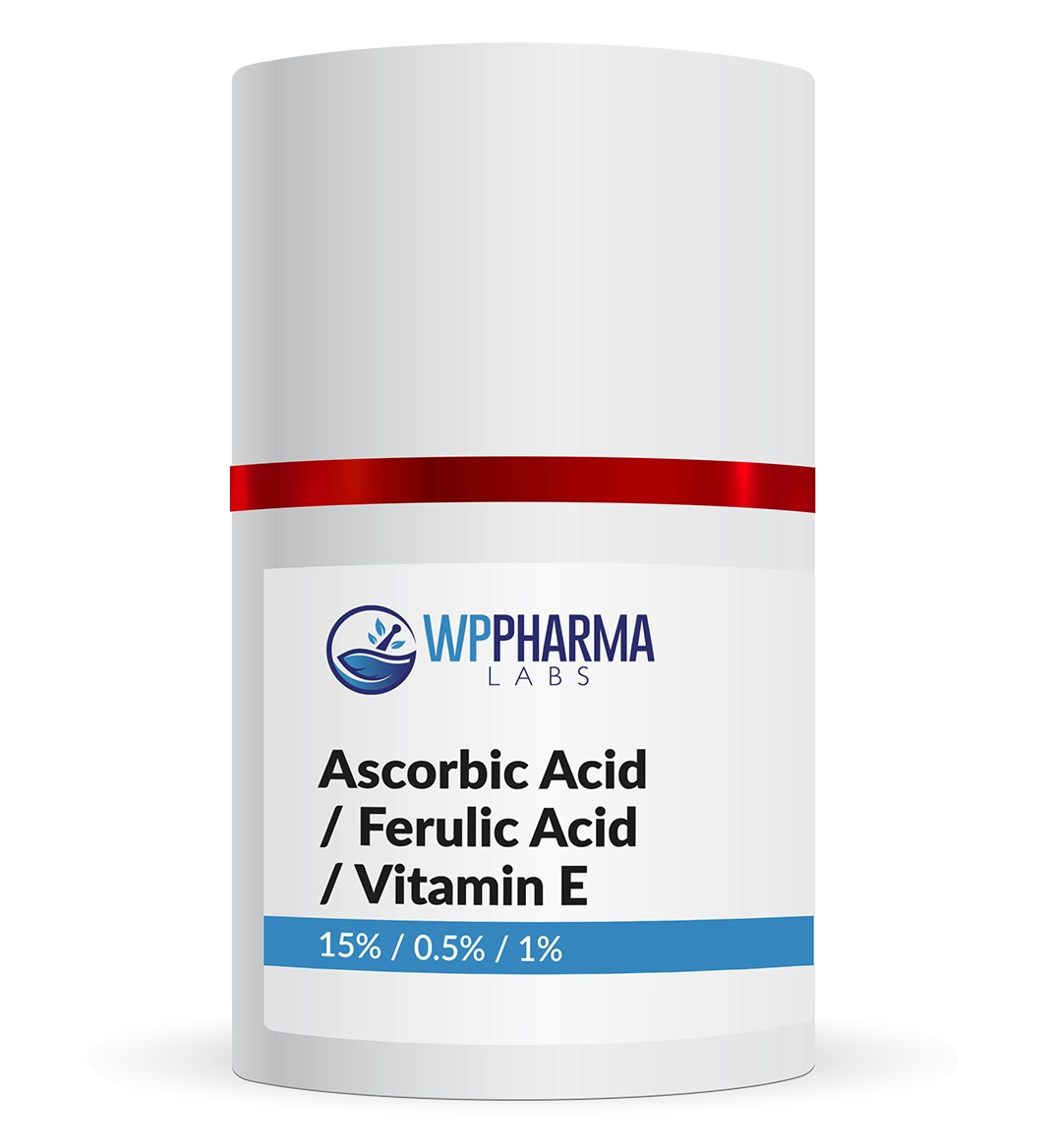
Ascorbic Acid / Ferulic Acid / Vitamin E – Facial Serum

(FA/C/E Complex) Facial Serum

15% / 0.5% / 1%

Ready to prescribe?
Disclaimer: Images are for reference only; actual products may vary.

Product Overview

This formula combine ascorbic acid, ferulic acid and vitamin E. These ingredients may work together to brighten the skin, reduce the appearance of fine lines and protect against environmental stressors. This powerful antioxidant combination may help improve skin tone and texture while providing essential hydration and protection. It may also help to decrease skin aging including fine lines, dullness, dryness, and loss of elasticity.

Ascorbic Acid1-5

Ascorbic acid (vitamin C) an antioxidant and a water-soluble vitamin is a critical co-factor for collagen biosynthesis, carnitine and catecholamine metabolism, and systemically dietary iron absorption. Ascorbic acid is an important component to ensure that skin has a healthy integrity. Along with its antioxidant properties for the skin, it may have the following activities: as an anti-inflammatory, as a depigmenting agent, and it may help in the development of collagen. Ascorbic acid deficiency causes skin aging. Thus, the external supplementation of ascorbic acid may be one of the attractive strategies for skin anti-aging.

Ascorbic acid is not made in the body and needs to be obtained through diet or through supplements. Dietary sources of ascorbic acid include citrus fruits, berries, tomatoes, potatoes and green leafy vegetables.

Ferulic Acid6,7,8

Ferulic Acid, a phenolic compound, is found in the cell walls of leaves and roots of many fruits and vegetables. It has potential medicinal properties including antioxidant, ant-inflammatory, anti-aging and antimicrobial activity. Although the chemical has poor solubility potentially limiting its use for therapeutic purposes, advances in nanotechnology have improved ferulic acid’s pharmacokinetic profile by encapsulating it in a matrix that is compatible with physiological fluids.

Vitamin E9

Vitamin E (or tocopherol), a fat-soluble vitamin, that functions as an antioxidant, protecting the cell membrane. The body does not form vitamin E and needs to be provided it exogenously. Vitamin E may prevent reactive oxygen species from forming and protect the biosynthesis of collagen and glycosaminoglycans in skin. Vitamin E may benefit the following dermatological conditions: atopic dermatitis, epidermolysis bullosa, psoriasis, wound healing, melasma, scleroderma, acne vulgaris and melasma.

Ascorbic Acid1-5

Ascorbic acid functions in the aqueous compartments of the cell. As an antioxidant, ascorbic acid neutralizes free radicals by donating electrons to prevent oxidative stress. Reactive oxygen species are formed when skin is exposed to ultraviolet light forming superoxide ions, peroxide and singlet oxygen species. Ascorbic acid facilitates collagen development. It plays an important role in the maturation of collagen. It is a critical co-factor for prolyl hydroxylase and lysl hydroxylase. The level of ascorbic acid in the skin is directly tied to the structural integrity of dermal collagen. As a depigmenting agent, ascorbic acid interacts with copper ions at the tyrosinaseactive site and inhibits action of the enzyme tyrosinase, thereby minimizing the melanin formation. Ascorbic acid interferes with NFkB activity and thus decreases the activity of a number of proinflammatory cytokines such as TNFalfa, IL1, IL6 and IL8.

Ferulic Acid6,7,8

Ferulic Acid may have several methods to support its role as a topical formulation including the following:

  • Antioxidant activity-Ferulic acid may scavenge free radicals and reactive oxygen species by enhancing the activity of the following antioxidant enzymes: superoxide dismutase, catalase, and glutathione peroxidase. These activities help support its role to decrease aging of the skin.
  • Anti-inflammatory activity-Ferulic acid targets pathways for inflammation. It may inhibit the production and release of pro-inflammatory cytokines such as TNF-α, IL-1β, and IL-6. It may also decrease the availability of cyclooxygenase-2 and inducible nitric oxide synthase that are involved in pro-inflammatory processes.

It may also modulate tyrosine kinase activity and have antimicrobial activity by disrupting bacterial cell membrane.

Vitamin E9

Gamma (γ) tocopherol is the most abundant vitamin E in the diet and alpha (α) tocopherol is the most abundant form of vitamin E in the skin. These forms of vitamin E are thought to inhibit the production of prostaglandin and nitric oxide, protect skin cells from sunburn and generally prevent oxidative stress in the skin.

Common1-9

  • Transient burning, erythema, itching, or discharge

Contraindications1-9

  • Hypersensitivity or intolerance to ascorbic acid, ferulic acid or vitamin E.

Precautions1-9

  • Ferulic acid should not be combined with retinoids or vitamin A-based products.

Store at 20°C to 25°C (68°F to 77°F) in a dry place, away from heat and light. Keep out of reach of children.

  1. Telang PS. Vitamin C in dermatology. Indian Dermatol Online J. 2013 Apr;4(2):143-6. doi: 10.4103/2229-5178.110593.
  2. Abdullah M, Jamil RT, Attia FN. Vitamin C (Ascorbic Acid). StatPearls. May 1, 2023. Accessed July 31,2025
  3. Boo YC. Ascorbic Acid (Vitamin C) as a Cosmeceutical to Increase Dermal Collagen for Skin Antiaging Purposes: Emerging Combination Therapies. Antioxidants (Basel). 2022 Aug 26;11(9):1663.
  4. Al-Niaimi F, Chiang NYZ. Topical Vitamin C and the Skin: Mechanisms of Action and Clinical Applications. J Clin Aesthet Dermatol. 2017 Jul;10(7):14-17.
  5. Clinical Pharmacology ascorbic acid clinical monograph 2025 https://www.clinicalkey.com/pharmacology/
  6. Purushothaman JR, Rizwanullah M. Ferulic Acid: A Comprehensive Review. Cureus. 2024 Aug 28;16(8):e68063.
  7. Roux J, Horton L, Babadjouni A, Kincaid CM, Mesinkovska NA. Ferulic Acid Use for Skin Applications: A Systematic Review. J Clin Aesthet Dermatol. 2025 May 1;18(5):38-42.
  8. What Are the Dangers of Ferulic Acid? https://us.typology.com/library/what-are-the-dangers-of-ferulic-acid Accessed August 27, 2027
  9. Keen MA, Hassan I. Vitamin E in dermatology. Indian Dermatol Online J. 2016 Jul-Aug;7(4):311-5.

WPPL operates as a 503A compounding pharmacy and prepares individualized prescription medications pursuant to provider direction. Compounded preparations are not reviewed, tested, or approved by the FDA.

This listing also includes commercially manufactured products for convenience; these items are not compounded by our pharmacy and are sold as provided by their manufacturers. Any statements regarding non-compounded products are manufacturer-supplied, have not been evaluated by the FDA, and are not intended to diagnose, treat, cure, or prevent any disease. WPPL does not verify or endorse any therapeutic claims made by manufacturers. Please refer to original labeling for complete product information.

EXPLORE MORE

Related Medications

Licensed to ship across the U.S.

Your orders arrive promptly and privately, delivered directly to your door.

Providers: Let’s Partner for Better Patient Care

If you are a physician, clinic, or practice seeking a dependable Compounding Pharmacy partner, WP Pharma Labs is here to help. With dedicated account setup, streamlined ordering and responsive service, we support your therapeutic goals with specialized compounds designed for your patients.

To check product availability, check on the status of an existing order, request refills:
orders@wppharmalabs.com

New providers setup / update an existing account:
newaccounts@wppharmalabs.com