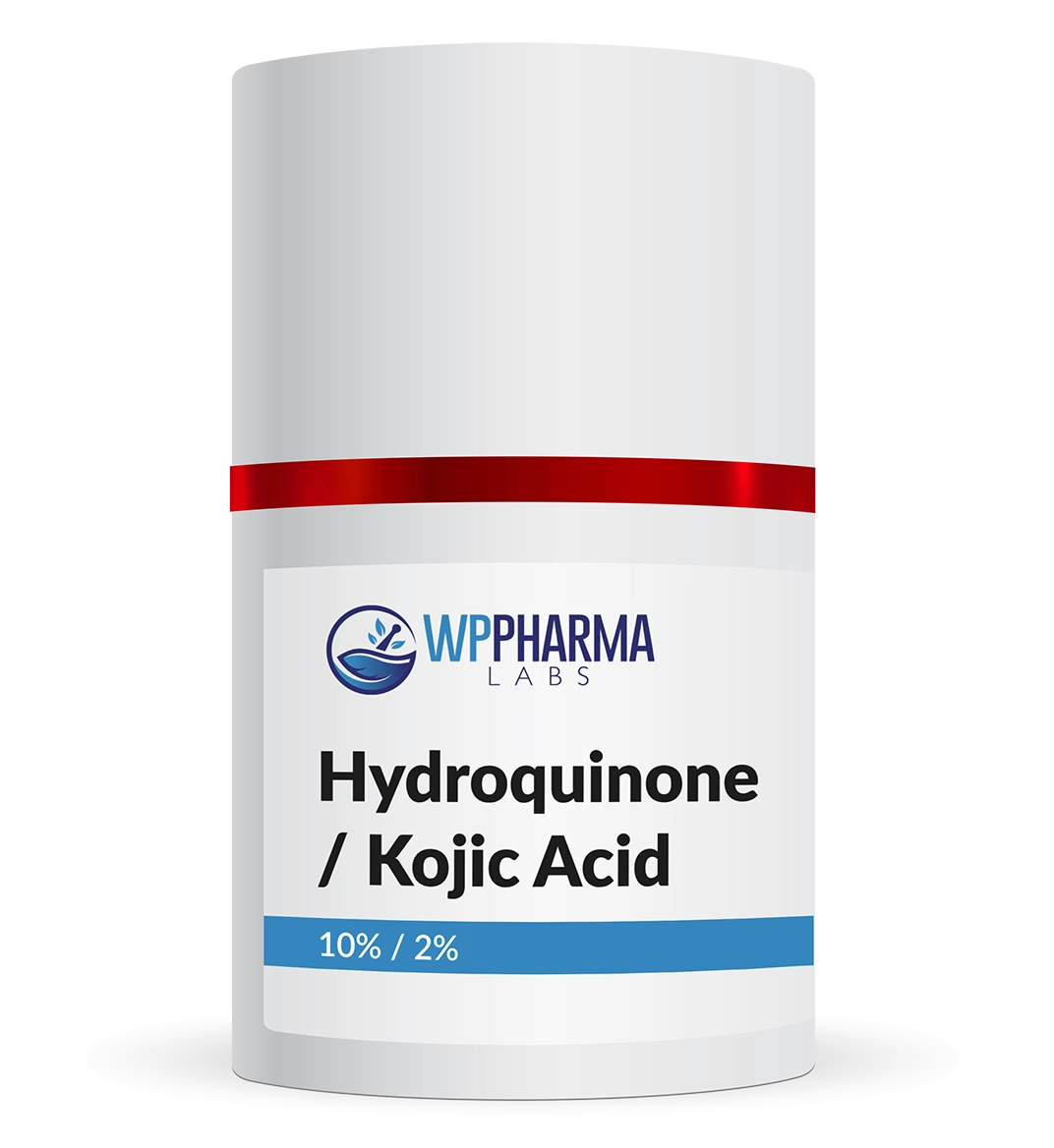
Hydroquinone / Kojic Acid

Cream

10% / 2%

Ready to prescribe?
Disclaimer: Images are for reference only; actual products may vary.

Product Overview

Hydroquinone / Kojic Acid Description1,2

Hydroquinone / Kojic Acid is a combined depigmentation or skin-lightening formulation used to manage melasma, chloasma, solar lentigines, freckles, and post-inflammatory hyperpigmentation. This combination is commonly used for hyperpigmentation, as both ingredients inhibit tyrosinase, the key enzyme in melanin synthesis.

Hydroquinone3,4

Hydroquinone is a phenolic organic compound with the molecular formula C₆H₆O₂. It has applications in both the photography and cosmetic industries. There is substantial evidence supporting its use as a skin-lightening agent. Hydroquinone is typically compounded at concentrations ranging from 2% to 12%. Its efficacy and safety depend on the final concentration, the formulation vehicle, and the chemical stability of the product. Skin-lightening effects may become noticeable within approximately two months of use.

Kojic Acid5-7

Kojic acid is an organic acid produced by various fungi, including Aspergillus flavus, A. oryzae, A. tamarii, and A. parasiticus. It was first isolated in 1907 and commercially marketed in 1955. Kojic acid is commonly used as a depigmenting agent and is also associated with antioxidant, antibacterial, and anti-inflammatory properties in addition to its skin-lightening effects.

Hydroquinone1-4

Hydroquinone affects the melanogenesis process by inhibiting tyrosinase. It also inhibits DNA and RNA synthesis and suppresses the formation of melanosomes. The ability of hydroquinone to affect the melanocyte metabolic process may lead to a decrease in the production of melanin.

Kojic acid1,2,5-7

Kojic acid is thought to chelate copper. Copper is needed at the active site of the tyrosinase enzyme. This action inhibits the activity of the tyrosinase enzyme. The tyrosinase enzyme is needed for melanin production.

Common3-9 

  • Burning sensation, irritation, erythema

Serious3-9 

  • Exogenous ochronosis with prolonged hydroquinone use

Contraindications3-9 

  • Hypersensitivity or intolerance to hydroquinone or kojic acid
  • Presence of active dermatitis, eczema, or open wounds at the application site

Precautions3-9 

  • Use with other agents that can dry or irritate the skin (retinoids, benzoyl peroxide)

Store at 20–25°C (68–77°F) in a cool, dry place, protected from light and moisture. Keep container tightly closed.

  1. Cassiano DP, Espósito ACC, da Silva CN, Lima PB, Dias JAF, Hassun K, Miot LDB, Miot HA, Bagatin E. Update on Melasma-Part II: Treatment. Dermatol Ther (Heidelb). 2022 Sep;12(9):1989-2012.
  2. Philipp-Dormston WG. Melasma: A Step-by-Step Approach Towards a Multimodal Combination Therapy. Clin Cosmet Investig Dermatol. 2024 May 22;17:1203-121
  3. Fabian IM, Sinnathamby ES, Flanagan CJ, Lindberg A, Tynes B, Kelkar RA, Varrassi G, Ahmadzadeh S, Shekoohi S, Kaye AD. Topical Hydroquinone for Hyperpigmentation: A Narrative Review. Cureus. 2023 Nov 15;15(11):e48840.
  4. Schwartz C, Jan A, Zito PM. Hydroquinone. https://www.ncbi.nlm.nih.gov/books/NBK539693/ August 22, 2023. Accessed July 22, 2025
  5. Zilles JC, Dos Santos FL, Kulkamp-Guerreiro IC, Contri RV. Biological activities and safety data of kojic acid and its derivatives: A review. Exp Dermatol. 2022 Oct;31(10):1500-1521.
  6. Saeedi M, Eslamifar M, Khezri K. Kojic acid applications in cosmetic and pharmaceutical preparations. Biomed Pharmacother. 2019 Feb;110:582-593.
  7. Phasha V, Senabe J, Ndzotoyi P, Okole B, Fouche G, Chuturgoon A. Review on the Use of Kojic Acid—A Skin-Lightening Ingredient. Cosmetics. 2022; 9(3):64.
  8. PandeyA, Jatana GK, Sonthalia S.Cosmeceuticals. https://www.ncbi.nlm.nih.gov/books/NBK544223/ Accessed July 22, 2025
  9. Bhattar PA, Zawar VP, Godse KV, Patil SP, Nadkarni NJ, Gautam MM. Exogenous Ochronosis. Indian J Dermatol. 2015 Nov-Dec;60(6):537-43.

WPPL operates as a 503A compounding pharmacy and prepares individualized prescription medications pursuant to provider direction. Compounded preparations are not reviewed, tested, or approved by the FDA.

This listing also includes commercially manufactured products for convenience; these items are not compounded by our pharmacy and are sold as provided by their manufacturers. Actual products in stock at time of dispensing may vary due to supply chain variability. Any statements regarding non-compounded products are manufacturer-supplied, have not been evaluated by the FDA, and are not intended to diagnose, treat, cure, or prevent any disease. WPPL does not verify or endorse any therapeutic claims made by manufacturers. Please refer to original labeling for complete product information.

EXPLORE MORE

Related Medications

Licensed to ship across the U.S.

Your orders arrive promptly and privately, delivered directly to your door.

Providers: Let’s Partner for Better Patient Care

If you are a physician, clinic, or practice seeking a dependable Compounding Pharmacy partner, WP Pharma Labs is here to help. With dedicated account setup, streamlined ordering and responsive service, we support your therapeutic goals with specialized compounds designed for your patients.

To check product availability, check on the status of an existing order, request refills:
orders@wppharmalabs.com

New providers setup / update an existing account:
newaccounts@wppharmalabs.com